
South Elgin Address History Sources
A South Elgin address can cross several record eras. The current tax card and deed lead into named owners, while directories, census schedules, newspapers, maps, and cemetery material add the people and events around the parcel. Start with the row that covers the likely period, then use a second source to test the match. The Recorder's office is the longest official land trail, but its precise web-index cutoff is not published.
| Source | Years It Covers | Where Held | What It Shows |
|---|---|---|---|
| Kane land records | Office research back to 1837 | Kane Recorder, Building C and online index | Deeds, parties, plats, liens, and legal descriptions |
| Elgin city directories | 1875 to present stated; address index about 1900 onward | Gail Borden Public Library | Names, addresses, firms, and printed notations |
| Selected South Elgin runs | 1909-10, 1913-14, 1917-18, 1921-1930 | Newberry inventory | Directory entries cataloged under Elgin |
| Evans' Elgin directory | 1933-1934 | FamilySearch image viewer | South Elgin person and address entries |
| Sanborn maps | 1887, 1891, 1897, 1903, 1913, 1939 | Gail Borden and map collections | Building footprint, use, and street context |
| Federal census | Public schedules through 1950 | National Archives and library databases | Households at one census date |
| Local newspapers | 1850s or 1870s through 2025 by title | Gail Borden and Elgin archives | Notices, obituaries, ads, and address changes |
For a recent house history, begin with DevNet and the deed index. For a home known only from family papers, start with the printed street spelling and date, then compare the directory, census, and map runs nearest that year.
Start South Elgin Records Today
The Kane DevNet parcel search accepts a PIN, owner name, or street address. Its card can show the physical, or situs, address; the tax mailing address; owner; legal description; sales history; taxing districts; and a deed document number. Mailing and situs fields may differ, so neither should be treated as proof of who sleeps at the property.
Copy the PIN and legal description exactly. A legal description identifies the land through a subdivision, lot and block or another survey-based form. It often remains stable when the street number does not. The KaneGIS4 viewer can confirm the parcel shape and municipality, but its lines are an approximate map aid, not a survey.
Note: An owner-occupied exemption is a useful clue, not proof that one person lived at the address without interruption.
Reverse the Kane County Deed Chain
The Kane Land Records Search provides name, document number, PIN, and advanced routes. Search is free and does not require an account. Online images and printouts are unofficial; certified copies come from the Kane County Recorder. The office research room at 719 S Batavia Avenue, Building C in Geneva has six public computers and land-title material back to 1837.
- Open today's DevNet card. Save the PIN, legal description, current owner, and any recent deed document number.
- Find the deed by PIN, document number, or current owner's name. Record the grantor, grantee, date, type, and description.
- Search the seller, or grantor, as a grantee in an earlier purchase. Match the land, not just a similar street number.
- Repeat for each transfer. Note mortgages, releases, liens, plats, and linked instruments without treating them as occupancy proof.
- When the web trail stops, use the Recorder's tract books, grantor/grantee books, and microfilm in Building C.
- Grantor and grantee
- The grantor transfers an interest; the grantee receives it.
- Chain of title
- The linked series of recorded transfers for the same land.
- Legal description
- The record language that identifies the parcel apart from its postal address.
The Recorder will not trace a whole title for a requester. A focused FOIA request may identify an existing document number, PIN range, or date span, while research itself belongs in the public room or index.
South Elgin's Online Cutoff Gap
Older previous residents can vanish from a web search even though the land records survive. Kane County states that office research reaches back to 1837, but no exact opening year for the online index was found. That makes the research-room fallback essential rather than optional. Staff can point to the tract, name, or microfilm tools, though they do not complete a title search for the visitor.
The Kane County Recorder is open weekdays from 8:30 a.m. to 4:30 p.m.; document and plat service have earlier daily cutoffs. Copies cost $1 per page under the published price list, while certified-copy charges are much higher. Confirm current fees before ordering.
The Kane County Genealogical Society site shows the countywide project network available when a deed trail reaches a surname, church, cemetery, or older index.
Its reported 385 projects and more than 1.2 million entries make it a finding aid, not a current resident roster or substitute for a deed.
One South Elgin House, Three Numbers
The Gail Borden house-research guide warns that Elgin-area address changes can leave one building under three numbers. Elgin's street-number changes in 1884 and 1894, plus the address index that appears around 1900, can create a false break in the previous-residents trail. Historical records may also say Clintonville, West Clinton, Elgin, or South Elgin.
Build a small crosswalk with the printed address, year, directory title, map sheet, legal description, and modern PIN. Do not overwrite the old form in notes. Search newspapers with each number and locality name. A legal description containing West Clinton may belong to a parcel whose current mailing city is South Elgin.
Note: A changed label can explain a gap, but the parcel description or map still needs to confirm that both numbers identify the same land.
Date South Elgin Buildings and Streets
Maps show whether the building existed when a named person appeared nearby. Gail Borden lists Sanborn fire-insurance maps for 1887, 1891, 1897, 1903, 1913, and 1939, plus atlases and maps from 1860 through 1960. Sanborn sheets can show footprints, construction material, use, additions, and street context. They do not name every resident.
The library's local history and house-research resources also point to selected annual construction reviews from 1886 to 1914. Modern South Elgin permit files are requested from Community Development because no complete public permit index was located. State the address, PIN, project type, and date span instead of asking staff for a broad house history.
Match South Elgin Past Households
Ownership is only half the story. A city directory entry may place a person or firm at an address even when the deed names someone else. Gail Borden states that Elgin city directories run from 1875 to the present, and the address index begins around 1900. Selected Newberry runs and the FamilySearch 1933-1934 Evans' Elgin volume add clear checkpoints. The collections themselves are described on the South Elgin city directory page.
- Choose a directory nearest the target year. Copy the name, address, spelling, abbreviations, and any spouse or firm notation exactly.
- Check the next earlier and later volumes. A one-year entry should remain a clue until another source agrees.
- Pair the result with the closest public census schedule. Use enumeration maps if the address was not indexed well.
- Compare household names with the deed dates, tax card, newspaper notices, and map evidence.
A directory publisher's entry does not prove continuous residence. The census is also a snapshot, not a year-by-year roll. Together they can reveal occupants who never appear as deed holders.
South Elgin Census Release Years
Federal census schedules become public after 72 years. The National Archives 1950 census portal is the official route for the latest released population schedule. It helps place a full household at one date and may supply ages, relationships, occupations, or a prior residence as the form permits.
Search the census with historic place labels and number variants, then compare each household to directories on both sides of the census year.
The Census Bureau explanation of the 72-year rule states when schedules open and notes that the 1960 census is due in 2032.
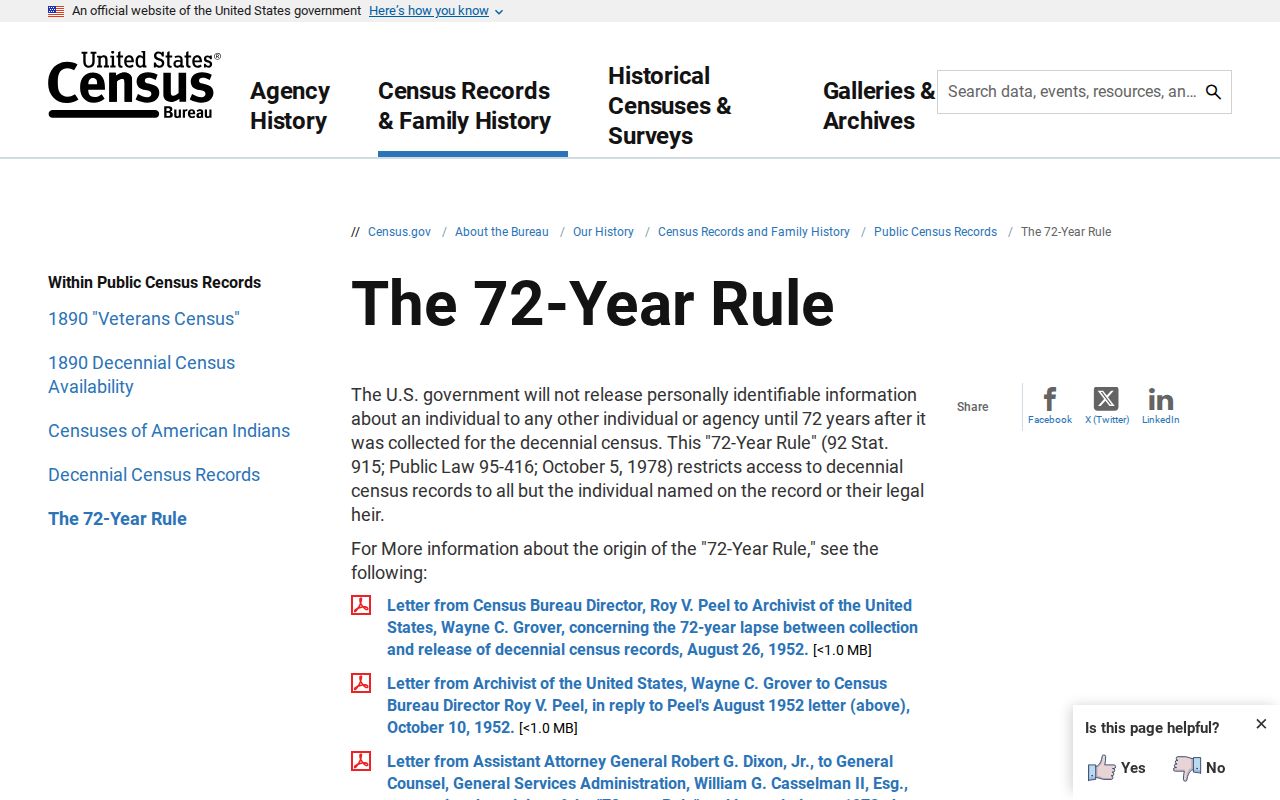
This release schedule explains why a recent household will not appear in public federal schedules.
Close a South Elgin Resident Chapter
Newspapers, obituaries, probate files, and cemetery records can explain why a household disappears between directory years. Gail Borden's digital archive spans several Elgin-area titles with keyword, date, title, and browse tools. The FamilySearch obituary index covers 1922-2017 and can return name, death, birth, place, spouse, and parents. Treat the index as a lead, then inspect the newspaper page.
South Elgin's municipal cemetery book may preserve a nickname, death place, age, plot, parent, relative, and remarks. A probate docket from the Kane Circuit Clerk may identify an estate process, while a later deed can show how the land moved. None should be made to say more than its own fields prove.
Keep a source log with the exact title, year, page, search spelling, and access date. Save the image number and collection name too. When two records disagree, preserve both readings and seek a third record tied to the same parcel or family.
Lawful use. Research previous residents for family history, estate work, or the story of a South Elgin house. Never use a record trail to watch, harass, or harm a living person.